Botanical remedies - Herbal Dispensary
Organic Soapwort root (Saponaria officinalis)
Organic Soapwort root (Saponaria officinalis)
Couldn't load pickup availability
Sustainably sourced from wild nature and premium organic or traditional farms
Botanical Remedies Organic Soapwort root, dried and cut (loose herbal tea)
Latin Name: Saponaria officinalis
- used traditionally for ages as medicine and washing agent
- only exceptional quality and purity root is chosen
- sustainable sourced
- premium replacement for any irritating synthetic washing agent
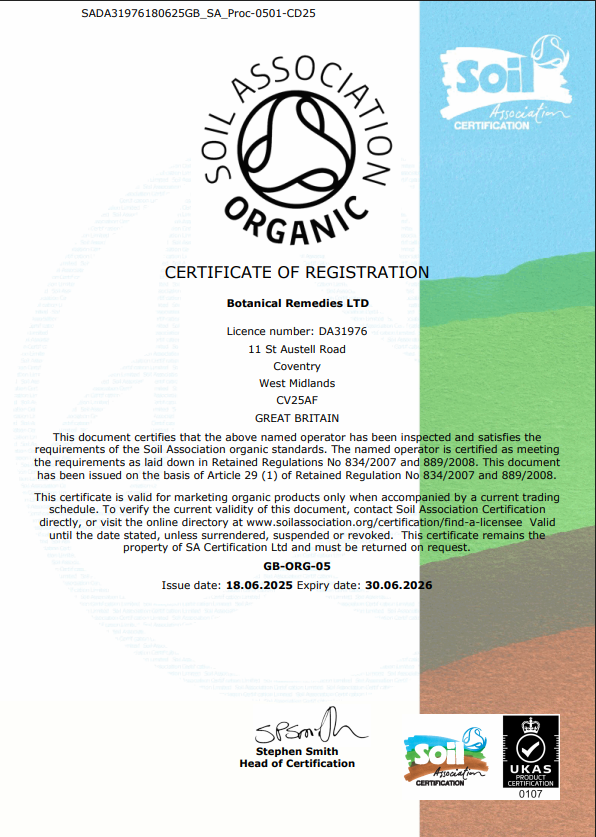
- certified organic to Soil Association Higher standards
- safe and efficient to be use by Herbalists
-
Practitioner grade
- manufactured in accordance with HACCP and GMP guidance
- restoring, dissolving, diluting, softening, stimulating qualities
- Considered as sweet, bitter, slightly pungent, cool, moist herb
- recognised in Tradition for tropism to the fluids, skin, lungs, and bladder
- Vegan and Vegetarian friendly
How to use Organic Soapwort root:
Soapwort root can be made in to powder, infusion, tincture, infused oil, vinegar, poultice, soap, shampoo and more.
How to prepare Organic Soapwort root tea:
To prepare Organic Soapwort root tea, add 1-2 teaspoons of ground or crushed root to a pan (not aluminium). Pour in a cup of cold water. Bring to boil, simmer for 15-30 minutes on low heat. Strain the tea and its ready. Soapwort root has many other uses. You can research the benefits of this herb or ask an herbalist how it can help you.
Safety of Organic Soapwort root:
Cautions and Contraindications:
- contraindicated in pregnancy
- contraindicated for bleeding and acute inflammation of the digestive system.
- Do not use orally for period time over 2 weeks
Other info about Organic Soapwort root:
Basic Botany of Soapwort:
Perennial, possesses leafy, unbranched, often straggling stems (sometimes tinged with red). It grows in patches, attaining a height of 70 cm. The broad, lanceolate, sessile leaves are opposite and between 4 and 12 cm long. Its sweetly scented flowers are pink, or sometimes white. Each of the five flat petals has two small scales in the throat of the corolla. They are about 2.5 cm wide, arranged in terminal clusters. The long tubular calyx has five pointed red teeth. Flowers June to September.
They are occasionally double flowered ('flore pleno')
Widespread as an occasional casual in much of Britain, but quite rare in Scotland.
Soapwort Other names:
- common soapwort,
- bouncing-bet,
- crow soap,
- wild sweet William,
- soapweed,
-
Mydlnica lekarska
Typical Ingredients of Organic Soapwort root:
100% pure Botanical, absolutely nothing added, exceptional quality and purity, dried and cut Organic Soapwort root (Saponaria officinalis)
Wild grown/Eco cultivated/Organic cultivated/Cultivated:
Organic certified to Soil Association higher standards
Country of origin:
Poland
Packaging:
All Organic products are hand packed in resalable PE packaging, comply with Soil Association higher standards
Vegetarian/Vegan Suitability:
Suitable for Vegetarians and Vegans
Quality assured
Benefits of Organic Soapwort root:
recognised in Tradition for tropism to the fluids, skin, lungs, and bladder. TCM recognise Soapwort as The herb which clears wind-damp skin and meridians congestion and tonify Qi at same time, Soapwort due to very high level of saponins is perfect replacement for commercial skin and hair care.
Because of UK law, we cannot provide any medicinal information about our herbs. However, at Botanical Remedies, we only offer herbs that have proven effects in literature or tradition. These herbs have been thoroughly tested in laboratories for authenticity, quality, and purity. Our herbs can be used efficiently and safely within recommended by literature doses.
Please do not confuse herbal teas widely available on the market with our herbs as there is huge difference between process and cost of production medicinal herbs and other herbal teas. Botanical Remedies offer only herbs that are efficient and safe to use by Herbalists.
Where can you find information about herbs?
You can look for details on herbs benefits, uses, and dosage. It's also important to know about safety and effectiveness. Additionally, consider the side effects. You can find both traditional and scientific knowledge on these topics.
Below few solid sources of information about herbs:
www.herbalreality.com web run by experienced Medical Herbalists
https://www.rjwhelan.co.nz web run by Medical Herbalist
https://botanicalremedies.co.uk/blogs/herbs blog run by Master Herbalist and Naturopath
Share