


Botanical remedies - Herbal Dispensary
Organic Bistort root (Polygonum bistorta)
Organic Bistort root (Polygonum bistorta)
Couldn't load pickup availability
Sustainably sourced from wild nature and premium organic or traditional farms
Botanical Remedies Organic Bistort root (or rather rhizome), dried and cut (loose herbal tea)
Latin Name: Polygonum bistorta
- used traditionally for ages as medicine and tanning agent
- only exceptional quality and purity root is chosen
- considered as extremally astringent herb
- sustainable sourced
- certified organic to Soil Association Higher standards
- safe and efficient to be use by Herbalists
-
Practitioner grade
- manufactured in accordance with HACCP and GMP guidance
- solidifying, astringing, stabilizing qualities
- Considered as very astringent, cool, dry herb
- recognised in Tradition for tropism to the intestines and bladder
- Vegan and Vegetarian friendly
How to use Organic Bistort:
Bistort root can be made in to powder, infusion, tincture, infused oil, vinegar, poultice, mouthwash, gargle and more.
How to prepare Organic Bistort root tea:
To prepare Organic Bistort root tea, add 1-2 teaspoons of ground or crushed root to a pan (not aluminium). Pour in a cup of cold water. Bring to boil, simmer for 15-30 minutes on low heat. Strain the tea and its ready. Bistort root has many other uses. You can research the benefits of this herb or ask an herbalist how it can help you.
Safety of Organic Bistort root:
Cautions and Contraindications:
- contraindicated in "empty cold conditions"
Other info about Organic Bistort root:
Basic Botany of Bistort:
Bistorta officinalis is an herbaceous perennial growing to 20 to 80 centimetres (8 to 31 in) tall by 90 cm (35 in) wide. It has a thick, twisted rootstock which has probably given it its common name of snakeroot. The foliage is normally basal with a few smaller leaves produced near the lower end of the flowering stems. The leaves usually hairless; the basal ones are longish-oval with long winged stalks and rounded or heart-shaped bases; the upper ones are few and are triangular, tapered and stalkless. There are stipules at their base which are fused into a sheath surrounding the stem. The petioles are broadly winged. The inflorescence is a spike. The plant blooms from late spring into autumn, producing tall, erect, unbranched, and hairless stems ending in single terminal racemes that are club-like spikes, 5–7 cm (2–3 in) long, of rose-pink flowers. The individual flowers are pink with five perianth segments, eight stamens, three fused carpels, and three free styles. The fruit is a glossy black nut. Flowering takes place in June and July. The plant grows in moist soils and under dry conditions goes dormant, losing its foliage until adequate moisture exists again.
History and folklore of Bistort:
"In many places, it can only be regarded as an escape from cultivation, its leaves and young shoots having formerly been widely used in the spring as a vegetable, being still, indeed, in the north of England an ingredient in Herb Pudding, under the name of 'Easter-mangiant,' the latter word a corruption of mangeant, i.e. a plant to be eaten at Easter, 'Easter Giant' and 'Easter Ledges' being variations of this name In Lancashire and Cumberland, the leaves and young shoots were eaten as a green vegetable under the name of Patience Dock and Passions. The roots and leaves had also a great reputation as a remedy for wounds, so that the plant was generally cultivated for medicinal use, as well as for employment as a vegetable.
The name Bistort (Latin bis = twice, torta = twisted) bears reference to the twice-twisted character of the root-stock, an old local name, 'Twice-Writhen,' being a literal translation of the Latin. Its twisted, creeping nature is also the origin of the names Snakeroot, Adderwort and Snakeweed. It was at one time called Serpentaria, Columbrina, Dracunculus and Serpentary Dragonwort, and has been thought to be the Oxylanathum Britannicum and Limonium of the ancients.
Externally, the root-stock is black, but internally is coloured red and is rich in tannic and gallic acids, which makes it a powerful astringent and has enabled it to be used in tanning leather, when procurable in sufficient quantity.
Besides being one of the strongest vegetable astringents among our native plants, the roots contain much starch, and after being steeped in water and subsequently roasted have been largely consumed in Russia, Siberia and Iceland in time of scarcity and are said after such preparation to be nutritious and a useful article of food, bread having been made of the root-flour of this and another Siberian species of Polygonum." (Modern herbal M. Grieve 1931)
Bistort Other names:
- Snakeweed
- Oderwort
- Sweet dock
- Rdest Wężownik
Typical Ingredients of Organic Bistort root:
100% pure Botanical, absolutely nothing added, exceptional quality and purity, dried and cut Organic Bistort root (Polygonum bistorta)
Wild grown/Eco cultivated/Organic cultivated/Cultivated:
Organic certified to Soil Association higher standards
Country of origin:
Poland
Packaging:
All Organic products are hand packed in resalable PE packaging, comply with Soil Association higher standards
Vegetarian/Vegan Suitability:
Suitable for Vegetarians and Vegans
Quality assured
Benefits of Organic Bistort root:
extremally astringent herb recognised in Tradition for tropism to the intestines and bladder
Because of UK law, we cannot provide any medicinal information about our herbs. However, at Botanical Remedies, we only offer herbs that have proven effects in literature or tradition. These herbs have been thoroughly tested in laboratories for authenticity, quality, and purity. Our herbs can be used efficiently and safely within recommended by literature doses.
Please do not confuse herbal teas widely available on the market with our herbs as there is huge difference between process and cost of production medicinal herbs and other herbal teas. Botanical Remedies offer only herbs that are efficient and safe to use by Herbalists.
Where can you find information about herbs?
You can look for details on herbs benefits, uses, and dosage. It's also important to know about safety and effectiveness. Additionally, consider the side effects. You can find both traditional and scientific knowledge on these topics.
Below few solid sources of information about herbs:
www.herbalreality.com web run by experienced Medical Herbalists
https://www.rjwhelan.co.nz web run by Medical Herbalist
https://botanicalremedies.co.uk/blogs/herbs blog run by Master Herbalist and Naturopath
Share

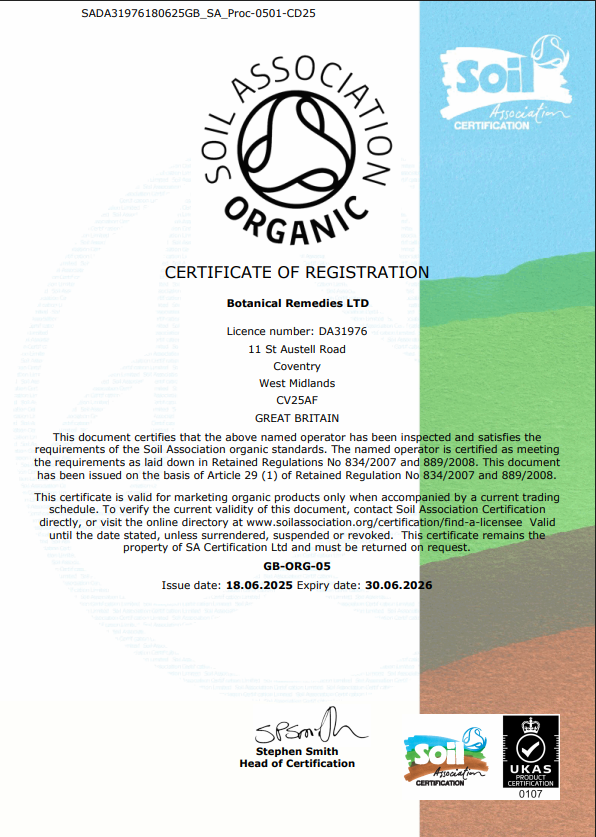


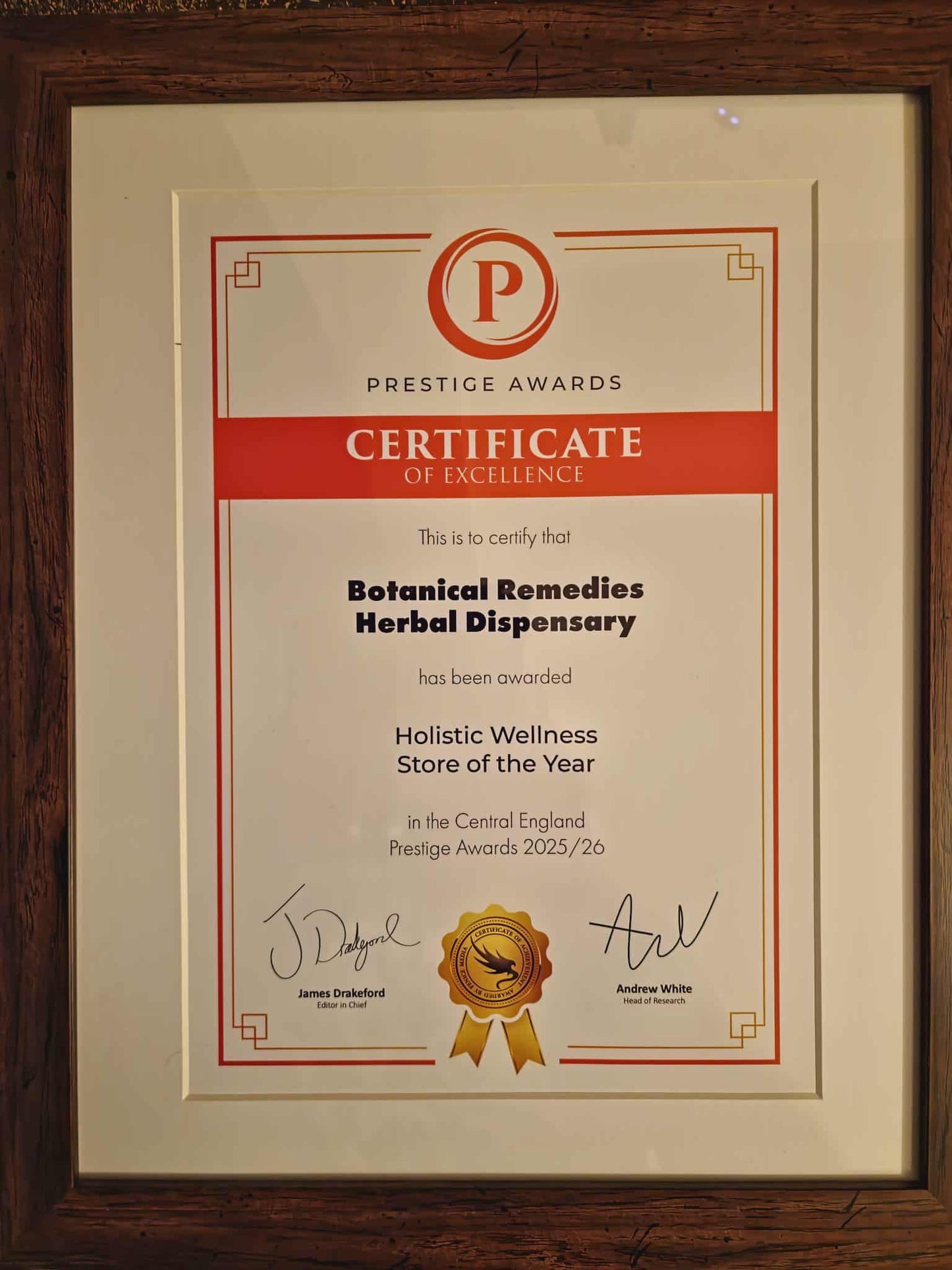
Certified Organic Product — Checked and verified by the Soil Association. View our official credentials